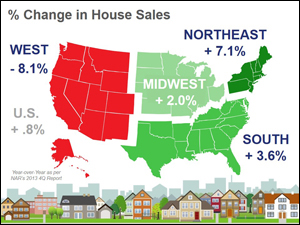
 Some industry gurus are questioning whether the housing momentum we saw early in 2013 began to dissipate later in the year. The more dramatic have claimed the housing sector is still on shaky ground. Others have blamed the slowdown in sales on a lack of consumer confidence or rising interest rates. The National Association of Realtors (NAR) just released their 2013 4th Quarter Housing Report. The report revealed that home sales numbers barely outperformed (an .08% increase) those in the 4th quarter of 2012. We believe the leveling in home sales is directly attributable to a lack of salable listing inventory; specifically in the West. Three of the four regions in the NAR report had an increase in sales: Northeast (+7.1%), Midwest (+2%) and South Regions (+3.6%). A big fall-off in sales occurred in the Western Region. The dramatic fall-off in the West (-8.1%) can be directly linked to a shortage of inventory in their hottest markets. If the decrease in sales was caused by an eroding of consumer confidence and/or rising interest rates, we believe each region would have seen similar decreases. Here on the Vineyard we are also experiencing a lack of inventory in most price ranges. This may be relieved as the weather improves (please - let the weather improve!). What homes are for sale are being looked at, even though its February. Perhaps the buying public is tired of waiting - even for their second home, which is our primary market. |
Wednesday, February 19, 2014
Home Sales Up in 3 of 4 Regions

Sunday, January 26, 2014
Proposed Revised Flood Plain Maps for Martha's Vineyard

I've just attended a seminar on new flood maps and how they will impact homeowners' insurance on Martha's Vineyard. The new maps increase the area of potential impact and future real estate sales. If a home is located within one of the zones and the buyer obtains a mortgage to purchase the property, the lending institution will require a certificate of elevation. A licensed land surveyor and several other professionals are licensed to do these at varying costs, depending where GIS sites are located, etc. This will create an added cost to the buyer/seller (not clear who should bear this cost yet). This certificate can delay the closing process by weeks. The insurance premiums will continue to increase over the years - as approved by the government, which guarantees the first $250K in these policies. The government (FEMA) and the insurance companies have depleted their reserves with the Hurricane Katrina and Sandy cleanups/payouts. So, the government has agreed that they can: increase the flood plains and insurance rates.
If there is no mortgage on the property, there is no requirement (as of today) for that homeowner to purchase flood insurance. However, if you currently have flood insurance on your property, expect the rates to increase, perhaps substantially.
The new maps are still a year or so away from being finalized as each municipality has the right to review and revise, plus there is an appeal period. For more information, please contact your insurance company. They will be able to definitively identify how this
may impact you and your home.
Do You Toss Those Bank Statement Inserts?
I usually do, but this time I decided to read it. And I decided that it contained some useful information worth sharing.
First I learned that my bank account/checks are protected by something called EZShield! Didn't know that and there's more.
Did you know? More than 1.2 million fraudulent checks are written each day - more than 13 per second?! (Office of the Comptroller of the Currency). Scary!
So here are some helpful tips on protecting your money and your identity.
1. Monitor your accounts and monthly statements to ensure their accuracy. Surprisingly, many people don't bother to balance their personal checkbooks! I guess I'm weird that way. Plus I look at my credit card statements carefully!
2. Each year, order copies of your credit report from each of the three major credit bureaus to verify their accuracy. This one bit me a few years ago. One of the credit bureaus combined my credit with the credit of someone whose name was similar (her credit wasn't as good). Could have been a catastrophe for me as I was in the middle of buying a house, but I did get it worked out.
3. Thoroughly shred documents containing any personal information before disposing. Think about what is on your bank statement - photocopies of your signature! Never mind the account number, where you spend money, etc.
4. Never write your Personal Identification Number of your ATM/Debit card. And never write your Social Security Number or credit card number on a check. We live in a password-protected society and it's hard to remember all the user names and passwords, but this advice is critical, and I would add that you shouldn't sign up for more credit cards or add PINs to existing cards if you don't need them!
5. Remove passwords, PINs and identification cards containing your Social Security Number from your purse or wallet. I'm removing mine today! Yikes!
6. Never put outgoing mail that may contain checks or tax documents in your mailbox at home. They know where you live!
7. At home, keep a checklist of the critical items stored in your wallet, purse, laptop and/or PDA. I can tell you that I was scared breathless when I left my laptop at the airport! (I was one of the lucky ones and did get it back - intact).
8. Only order from internet sites that use secure methods of obtaining personal account or credit card information. Duh!
9. Always log off after an online banking session. No need to elaborate on this tip!
If you suspect your identity has been stolen/compromised:
1. Immediately file a report with your local police.
2. Call the Federal Trade Commission at 1-877-ID-THEFT.
3. Contact the three major credit bureaus to place a fraud alert on your record.
4. Maintain a record of each contact with authorities.
So, that's most of what was on that little piece of paper that was in with my bank statement. My thanks!
First I learned that my bank account/checks are protected by something called EZShield! Didn't know that and there's more.
Did you know? More than 1.2 million fraudulent checks are written each day - more than 13 per second?! (Office of the Comptroller of the Currency). Scary!
So here are some helpful tips on protecting your money and your identity.
1. Monitor your accounts and monthly statements to ensure their accuracy. Surprisingly, many people don't bother to balance their personal checkbooks! I guess I'm weird that way. Plus I look at my credit card statements carefully!
2. Each year, order copies of your credit report from each of the three major credit bureaus to verify their accuracy. This one bit me a few years ago. One of the credit bureaus combined my credit with the credit of someone whose name was similar (her credit wasn't as good). Could have been a catastrophe for me as I was in the middle of buying a house, but I did get it worked out.
3. Thoroughly shred documents containing any personal information before disposing. Think about what is on your bank statement - photocopies of your signature! Never mind the account number, where you spend money, etc.
4. Never write your Personal Identification Number of your ATM/Debit card. And never write your Social Security Number or credit card number on a check. We live in a password-protected society and it's hard to remember all the user names and passwords, but this advice is critical, and I would add that you shouldn't sign up for more credit cards or add PINs to existing cards if you don't need them!
5. Remove passwords, PINs and identification cards containing your Social Security Number from your purse or wallet. I'm removing mine today! Yikes!
6. Never put outgoing mail that may contain checks or tax documents in your mailbox at home. They know where you live!
7. At home, keep a checklist of the critical items stored in your wallet, purse, laptop and/or PDA. I can tell you that I was scared breathless when I left my laptop at the airport! (I was one of the lucky ones and did get it back - intact).
8. Only order from internet sites that use secure methods of obtaining personal account or credit card information. Duh!
9. Always log off after an online banking session. No need to elaborate on this tip!
If you suspect your identity has been stolen/compromised:
1. Immediately file a report with your local police.
2. Call the Federal Trade Commission at 1-877-ID-THEFT.
3. Contact the three major credit bureaus to place a fraud alert on your record.
4. Maintain a record of each contact with authorities.
So, that's most of what was on that little piece of paper that was in with my bank statement. My thanks!
Friday, January 24, 2014
Your Home Maintenance Checklist!
-

Is Your Home Older Than Its Years?
Would you throw away $20,000? You are if you’re letting your home age faster than it should. Here’s a simple maintenance strategy to keep your home young. Read
Visit houselogic.com for more articles like this.
Copyright 2014 NATIONAL ASSOCIATION OF REALTORS®
Thursday, January 9, 2014

Susan
Cahoon, Principal and Broker of Homes on Martha’s Vineyard, was recently
awarded the National Association of Realtors’ SRES designation. SRES, which stands for Seniors Real
Estate Specialist, is earned when a Realtor completes a training course and
passes an examination. SRES professionals
are well-versed in the needs of our growing and aging population, from the “GI
Generation” to the “Millennials”.
“Senior” now encompasses anyone over the age of 50! “Our needs are often complex, and must
address a range of services, while still considering the must-haves of younger
family members”, said Susan. “That’s why getting this additional training and
knowledge was so important to me.”
An SRES Realtor has access through a wide network of professionals who
provide specialized from reverse mortgages to identifying appropriate adult or
assisted-living communities.
Susan
has been a real estate professional since 1975, working in management, sales,
property management and development in both residential and commercial real
estate in the Suburban Boston and Cape Cod and Islands market. She and her business partner, Tjark
Aldeborgh, opened Homes on Martha’s Vineyard in 2011 at Post Office Square in
Edgartown. Homes on Martha’s
Vineyard offers a full range of real estate services – sales, rentals and
property management. A full-time,
year round business, their real estate agents are committed and caring; making
sure that their customers are treated with unequaled service and
professionalism. Susan can be
reached at 508-939-0206 or at Susan@HomesonMVY.com.
Monday, December 16, 2013
4 Pitfalls to Selling Your Home for the Best Price in the Shortest Amount of Time
You've decided to sell your home. Great! Now
what? Many folks who make the decision to sell their home fall victim to the
following four pitfalls. By educating yourself about some common missteps you
can save yourself from making a costly mistake when hiring an agent and listing
your home.
1) Overpricing - It's no surprise
that every owner wants the highest possible sale price for their property. This
desire is one that some agents take advantage of by selling you on an
unrealistically high list price. Once they have a signed listing agreement
they'll bank on price reductions to sell your home. The problem with this
tactic is that it costs homeowners thousands of dollars. A property that is originally
listed too high not only squanders its first few weeks on market but also
carries a stigma throughout its life on-market due to the unrealistic original
list price. All this results in lower demand down the road and a lower sale
price. It's important to remember when interviewing agents that the highest
suggested price is not always the best. Make sure to ask your agent for
specifics on how they arrived at their price suggestion.
Experience
shows that the highest price is realized within the first 30 days of being
offered for sale on the open market.
2) Not Managing Expectations -
Real estate is very much a perception based industry. Buyers want to feel like
they are receiving good value. Many times agents try to stretch the truth by
counting a glorified hallway as an extra bedroom, only to have potential buyers
disheartened when actually viewing the home. One of the jobs of a good agent is
to accentuate the home's positives and frame things in a way that adds
perceived value to a home. Rather than listing a home with an extra bedroom,
listing it with a utility room can turn a disappointed buyer into an excited
one as they discover a useful extra space. Many times in our industry
perception is reality and buyers who leave a property feeling great about all
the "additional" value a home offered will be far more likely to put
in an offer than those who left disappointed about the tiny bedroom.
As a
Realtor, we have an obligation to relay the information about a house
honestly. Further, we also request
the seller fill out a “Seller’s Statement of Condition”. We follow up by verifying information
with the appropriate local authorities to clarify such potential questions such
as zoning, side-line setbacks, etc.
This helps to avoid surprises that could impact the transaction.
3) Not Making the Best First Impression -
You know the old saying a picture is worth 1,000 words? Well in real estate
they are probably worth 100,000. Too many times sellers allow their agents to
take photos with a cell phone or take photos themselves. Today's buyers are
making snap decisions viewing homes online and are basing these judgements off
your photos. Hence they need to be high definition, clear, and purposeful. You
are telling a story with your media plan and want to entice buyers to see your
home in person. The single best way to turn off potential buyers is with poorly
lit, poorly edited, and poorly executed photos. Additionally, video is becoming
huge in real estate as even more of the house hunting process is taking place
online. Ask your agent about adding HD Video to your listing to further entice
interested buyers to your property.
As
your Realtor, I will be at all showings early, in order to turn on the lights,
de-clutter, put the dog out, etc.
When we list your home, we’ll offer suggestions on how best to present
your home to prospective buyers.
Some can overlook your personal “stuff”, and some can’t. Don’t take the chance! Put your best look forward! Studies have shown that landscaping can
increase the amount realized by as much as 5%!
4) Not having a Customized Marketing Plan -
Our last pitfall is one that many sellers fall into. Many agents you will interview
will not have a specific plan to market your home. They will instead rely on
scripts and a standard listing presentation to get you to sign on the dotted
line. After that they'll simply list your home on MLS and hope buyers find it.
Marketing for homes cannot be one-size-fits-all. Every home has a distinct set
of buyers that will be interested in it and every set of buyers has a distinct
way to be reached. Ask your agent who your home will appeal to and how they
plan to proactively market to them. If their plan relies heavily around
submitting your listing to hundreds of sites you've never heard of you may want
to stay away.
We do
have a marketing plan with aspects that some agencies do and some that most
agencies do not. Our agent will go
over it with you and tailor it to your needs and concerns. The best current information indicates
that the internet is the number one method of attracting buyers; signs continue
to be number 2!
Tuesday, December 10, 2013
Psst! Harvard Talks Homeownership!

Eric Belsky is Managing Director of the Joint Center of Housing Studies at Harvard University. He also currently serves on the editorial board of the Journal of Housing Research and Housing Policy Debate. This year he released a new paper on homeownership - The Dream Lives On: the Future of Homeownership in America. In his paper, Belsky reveals five financial reasons people should consider buying a home.
Here are the five reasons, each followed by an excerpt from the study:1.) Housing is typically the one leveraged investment available. “Few households are interested in borrowing money to buy stocks and bonds and few lenders are willing to lend them the money. As a result, homeownership allows households to amplify any appreciation on the value of their homes by a leverage factor. Even a hefty 20 percent down payment results in a leverage factor of five so that every percentage point rise in the value of the home is a 5 percent return on their equity. With many buyers putting 10 percent or less down, their leverage factor is 10 or more.” 2.) You're paying for housing whether you own or rent. “Homeowners pay debt service to pay down their own principal while households that rent pay down the principal of a landlord.” 3.) Owning is usually a form of “forced savings”. “Since many people have trouble saving and have to make a housing payment one way or the other, owning a home can overcome people’s tendency to defer savings to another day.” 4.) There are substantial tax benefits to owning. “Homeowners are able to deduct mortgage interest and property taxes from income...On top of all this, capital gains up to $250,000 are excluded from income for single filers and up to $500,000 for married couples if they sell their homes for a gain.” 5.) Owning is a hedge against inflation. “Housing costs and rents have tended over most time periods to go up at or higher than the rate of inflation, making owning an attractive proposition.” Bottom LineWe realize that homeownership makes sense for many Americans for many social and family reasons. It also makes sense financially.- courtesy of KCM - Keeping Current Matters |
Subscribe to:
Posts (Atom)